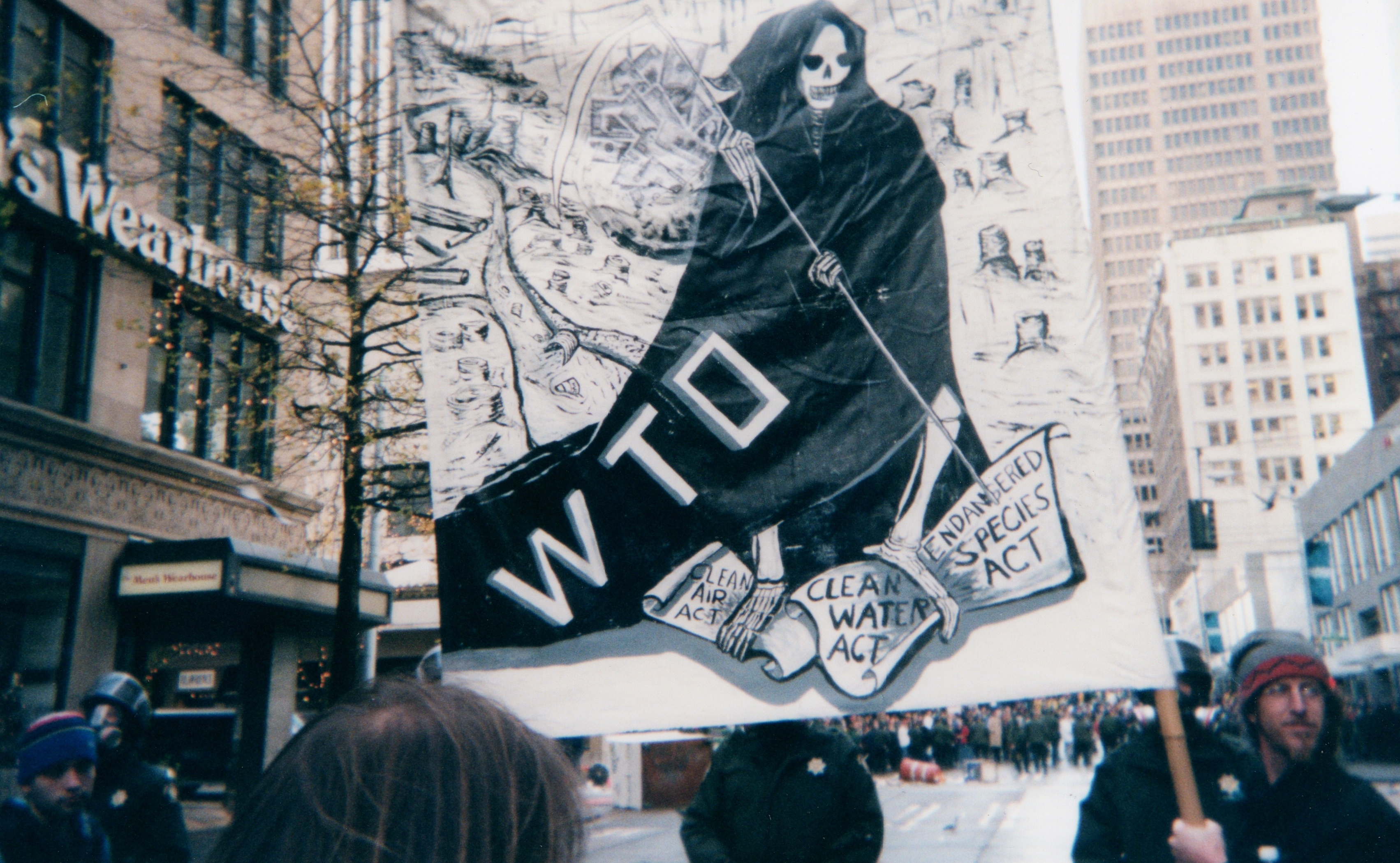
On November 30, 1999, Seattle woke up to find itself at the center of a global confrontation it didn't ask for and wasn't prepared to handle. Over 40,000 protesters — environmentalists, labor unions, anarchists, students, and a guy in a sea turtle costume — converged on downtown to shut down the World Trade Organization's ministerial conference. The city's response involved tear gas, rubber bullets, a declared state of emergency, and the National Guard patrolling Pike Place Market.
The protesters won. The conference collapsed. And Seattle became synonymous with a new kind of activism — decentralized, media-savvy, and willing to break things to make a point. Twenty-five years later, the "Battle of Seattle" remains the blueprint for how to disrupt a global summit and the cautionary tale for what happens when a city underestimates just how many people care about trade policy.

Why Seattle?
The World Trade Organization chose Seattle for its 1999 ministerial conference because the city seemed like a safe, progressive, business-friendly host. Microsoft and Boeing were headquartered nearby. The city had successfully hosted international events. Mayor Paul Schell was enthusiastic about putting Seattle on the global stage.
What the WTO didn't anticipate was that Seattle's progressive reputation would attract every activist group in North America. Environmental organizations opposed WTO policies they believed undermined environmental protections. Labor unions saw the WTO as a tool for outsourcing American jobs. Anarchist collectives saw an opportunity to confront global capitalism. Student groups, human rights organizations, and indigenous rights activists all had grievances.
They all showed up. At the same time. In the same city.
"We thought maybe 5,000 people would show up. We got 40,000. The city wasn't ready. Hell, we weren't ready."
— Norm Stamper, Seattle Police Chief (resigned after WTO)
November 30: N30
The protests began early on November 30 — later known simply as "N30" in activist circles. By 7:00 AM, protesters had formed human chains blocking intersections around the Washington State Convention and Trade Center, where the WTO conference was scheduled to begin. The tactic was simple: non-violent civil disobedience. Lock arms, sit down, don't move.
It worked. WTO delegates couldn't reach the venue. The opening ceremony was delayed, then canceled. By mid-morning, downtown Seattle was gridlocked. An estimated 40,000 to 50,000 people filled the streets — far more than police or city officials had anticipated.
The crowd was diverse. AFL-CIO members marched in organized labor contingents. The Ruckus Society trained activists in non-violent direct action. The Direct Action Network coordinated affinity groups. And then there was the Black Bloc — anarchists dressed in black, faces covered, who had no interest in peaceful protest.

The Black Bloc
The Black Bloc wasn't an organization — it was a tactic. Protesters dressed in black clothing and masks to maintain anonymity and present a unified front. While most protesters engaged in non-violent civil disobedience, the Black Bloc smashed windows of corporate targets: Starbucks, Nike, Gap, Bank of America. Their property destruction dominated media coverage and became the defining image of the protests.

The Police Response
Seattle police were overwhelmed. They hadn't trained for this scale of protest. Their crowd control tactics escalated quickly: pepper spray at 10:00 AM, tear gas by noon, rubber bullets by mid-afternoon. Officers in riot gear fired projectiles into crowds that included non-violent protesters, journalists, and bystanders.
The images were shocking. Police spraying seated protesters directly in the face. Clouds of tear gas rolling through downtown intersections. Rubber bullets fired at close range. A pregnant woman miscarried after being hit with a beanbag round. Elderly activists were clubbed. Journalists wearing press credentials were arrested.
By evening, Mayor Paul Schell declared a civil emergency and imposed a 7:00 PM to 7:30 AM curfew on a 50-block area of downtown. He called in the National Guard. Protests that began as non-violent civil disobedience had become a full-scale confrontation between citizens and militarized police.

"This was not what we signed up for. We wanted to disrupt the summit, not get tear-gassed in front of Nordstrom."
— Han Shan, Direct Action Network organizer
The Broken Windows
The property damage became the story. Black Bloc protesters systematically targeted symbols of corporate globalization. Starbucks bore the brunt — nearly every downtown location had its windows smashed. Nike, Gap, Old Navy, Warner Bros. Store, Planet Hollywood, and Bank of America were also hit. The damage was estimated at $2.5 million to $3 million.
The Black Bloc defended the destruction as symbolic resistance to corporate power. Critics argued it undermined the legitimacy of the broader protest movement. Media coverage focused almost exclusively on the violence, often ignoring the tens of thousands of peaceful demonstrators.
What's often forgotten: the vast majority of protesters were non-violent. Labor unions, environmental groups, and faith-based organizations explicitly condemned property destruction. But nuance doesn't play well on television. The image of masked protesters smashing Starbucks windows became the defining visual of the Battle of Seattle.
The Media Paradox
Peaceful protests rarely make international news. Property destruction does. The Black Bloc's tactics ensured global media coverage, which amplified the protesters' message about corporate globalization. But that same coverage framed the movement as violent and chaotic, alienating potential sympathizers. The protesters got attention. The cost was credibility.
December 1-3: The Siege
The protests continued for three more days. Police arrested over 600 people, many held without charges in King County Jail. The "no-protest zone" downtown was enforced with checkpoints and ID checks. Residents couldn't enter their own neighborhoods without proving they lived there. The National Guard patrolled streets with armored vehicles.

Inside the convention center, the WTO conference was falling apart. Developing nations walked out, accusing wealthy countries of excluding them from negotiations. Disagreements over agriculture, intellectual property, and environmental standards couldn't be resolved. On December 3, the conference ended without reaching an agreement on a new trade round.
The protesters had achieved their goal: they shut down the WTO. The talks collapsed not just because of street protests, but because the protests exposed and amplified internal divisions within the WTO itself. The "Battle of Seattle" proved that direct action could disrupt global summits and embolden dissenting voices within those institutions.
The Aftermath
The political fallout was immediate. Seattle Police Chief Norm Stamper resigned on December 7, 1999, taking responsibility for the department's failed response. Mayor Paul Schell's political career never recovered — he lost re-election in 2001. The city commissioned investigations into police conduct, which documented widespread civil rights violations.
Over 600 arrests resulted in very few convictions. Most charges were dropped. The ACLU filed lawsuits on behalf of protesters whose rights were violated. The city eventually paid settlements totaling over $250,000 to protesters who were wrongfully arrested or injured by police.
For the WTO, Seattle was a public relations disaster. Subsequent summits were held in remote locations — Doha, Qatar in 2001, Cancún, Mexico in 2003 — specifically chosen to make large-scale protests logistically difficult. The organization never recovered its pre-Seattle momentum.
"Seattle changed everything. Before WTO, people didn't think you could stop a global summit. After Seattle, every major summit faced protests. We proved it could be done."
— Naomi Klein, Author, "No Logo"
The Legacy
The Battle of Seattle became the template for 21st-century protest movements. The tactics used — affinity groups, non-hierarchical organizing, media-savvy messaging, strategic property destruction — were replicated at subsequent summits: Washington D.C. (2000), Prague (2000), Genoa (2001), and later at Occupy Wall Street (2011) and beyond.
It also marked the emergence of the anti-globalization movement as a mainstream political force. Before Seattle, opposition to free trade agreements was considered fringe. After Seattle, it became a central debate in American politics. The coalition that formed in Seattle — labor unions, environmentalists, human rights groups — influenced trade policy for the next two decades.
For Seattle, the protests became part of the city's identity. The city that brought you grunge and Microsoft also brought you the most effective protest against corporate globalization in modern history. It was a reputation the city both embraced and struggled with — progressive enough to host major dissent, but establishment enough to tear-gas its own citizens when that dissent got too disruptive.
The Numbers
40,000-50,000 protesters. 600+ arrests. $2.5-3 million in property damage. Zero trade agreements signed. The WTO ministerial conference was the first in the organization's history to end without a declaration or agreement. By that measure, the protesters won.
What They Got Wrong
The anti-globalization movement predicted that the WTO would undermine labor rights, environmental protections, and national sovereignty. Some of those predictions came true. Others didn't. Global trade continued to expand. Developing nations saw economic growth, though inequality within those nations often worsened. Environmental and labor protections remain unevenly enforced.
The movement also didn't anticipate how globalization would evolve. The WTO's influence waned, but not because of protests — it was supplanted by bilateral trade agreements and the rise of China as an economic superpower operating outside WTO frameworks. The protesters were fighting the last war while the next one was already beginning.
And the property destruction debate never resolved. Was smashing Starbucks windows justified political expression or counterproductive vandalism? Twenty-five years later, activists still argue about it. The only consensus: it got attention.
What They Got Right
The protesters understood something that most political elites missed: trade policy isn't just economics, it's power. The WTO made decisions that affected workers, environmental standards, and public health — but those decisions were made behind closed doors by unelected officials representing corporate interests. The Battle of Seattle forced those conversations into public view.
They also proved that decentralized movements could challenge centralized power. There was no single leader, no official organization, no unified demand. The diversity that made the movement chaotic also made it resilient. You can't co-opt or arrest a movement that has no center.
And they normalized protest as a political tool for a new generation. Before Seattle, mass demonstrations seemed like relics of the 1960s. After Seattle, they became a regular feature of political life. Every major summit now expects protests. That's the Battle of Seattle's most enduring legacy: the expectation that citizens can and will disrupt power when they disagree with it.
Walk through downtown Seattle today and you won't find many physical reminders of November 1999. The broken windows were replaced. The Starbucks locations reopened (most of them, anyway). The Washington State Convention Center still hosts conferences. Pike Place Market still sells flowers and fish.
But the political landscape changed. Trade policy became a campaign issue. Corporate accountability entered mainstream discourse. Activism adopted new tactics. And Seattle — progressive, corporate, contradictory Seattle — became the city where 40,000 people proved that global summits could be disrupted, that decentralized movements could win, and that sometimes, breaking windows gets more attention than holding signs.
The WTO never held another ministerial conference in the United States. That might be the most telling detail of all. They didn't want to risk another Seattle. The protesters made sure of that.
Remembering N30
The WTO History Project maintains an archive of photos, videos, and oral histories from the Battle of Seattle at wtohistory.org. The Seattle Public Library has a special collection documenting the protests. Every November 30, activists gather at Victor Steinbrueck Park to commemorate the anniversary.